 Sign up

ASEAN's Green Economy
is being stress-tested
in 2026.
The Strait of Hormuz closure, a Super El Niño, and cascading compliance mandates are landing at once. This is the year resilience stopped being a framework and became a requirement. Mapped across 1,150 startups and SMEs, seven sectors, and six countries — for the third year running.
 SG
SG
 ID
ID
 MY
MY
 TH
TH
 VN
VN
 PH
PH
Sectors
7 thematic clusters
1,150
3rd · 2026
1,150
Startups, scale-ups & SMEs mapped
Across ASEAN-6 by primary industry classification
US$300B
Annual green economy opportunity
Bain & Co / GenZero / Temasek by 2030
54%
Of regional emissions from FALU
Food, agriculture & land use — biggest lever
US$200B+
Annual climate investment needed
Beyond reach of traditional finance
2026 is not a routine year. It is a genuine stress test — and that changes what resilience means.
A Strait of Hormuz closure, a Super El Niño, and cascading compliance mandates have landed simultaneously across ASEAN. The green economy's case no longer rests on climate alone — it is now an energy security argument, a food security argument, and an industrial competitiveness argument at once. Among the 1,150 startups and SMEs mapped in this Landscape, a clear role emerges: they are the integration layer of the transition — and in 2026, that integration work is no longer optional.
The Year of Resilience.
In 2026, the Strait of Hormuz closure, a Super El Niño, and accelerating compliance mandates have landed simultaneously. Resilience is no longer a framework — it is the operating context. We assess every story in this Landscape across three dimensions.
Climate Resilience
The capacity of ecosystems and communities to withstand physical shocks — from extreme heat and flooding to storm surges and crop loss. Measured by how directly an innovation addresses physical climate exposure.
Economic Resilience
Reduced dependence on fragile supply chains and imported inputs — from fossil fuels and fertilisers to food and critical minerals. Measured by how much an innovation cuts import exposure or builds self-sufficiency.
Social Resilience
Whether the transition strengthens livelihoods and community stability rather than displacing them. Measured by whether an innovation includes or benefits the people most exposed — smallholder farmers, informal workers, and low-income communities.
Context: the 2026 shocks
The Strait of Hormuz closure in February 2026 pushed nitrogen fertiliser prices up 30%+ and exposed ASEAN's structural dependence on imported fossil fuels. A Super El Niño is intensifying through H2 2026, threatening yields across Indonesia, Malaysia, the Philippines, and Vietnam. Both shocks land together — not sequentially — making 2026 a genuine test of the region's resilience across all three dimensions.
Resilience ratings in each sector
★★★ High impact
★★★ Moderate impact
★★★ Limited impact
Different starting points. Same structural opportunity.
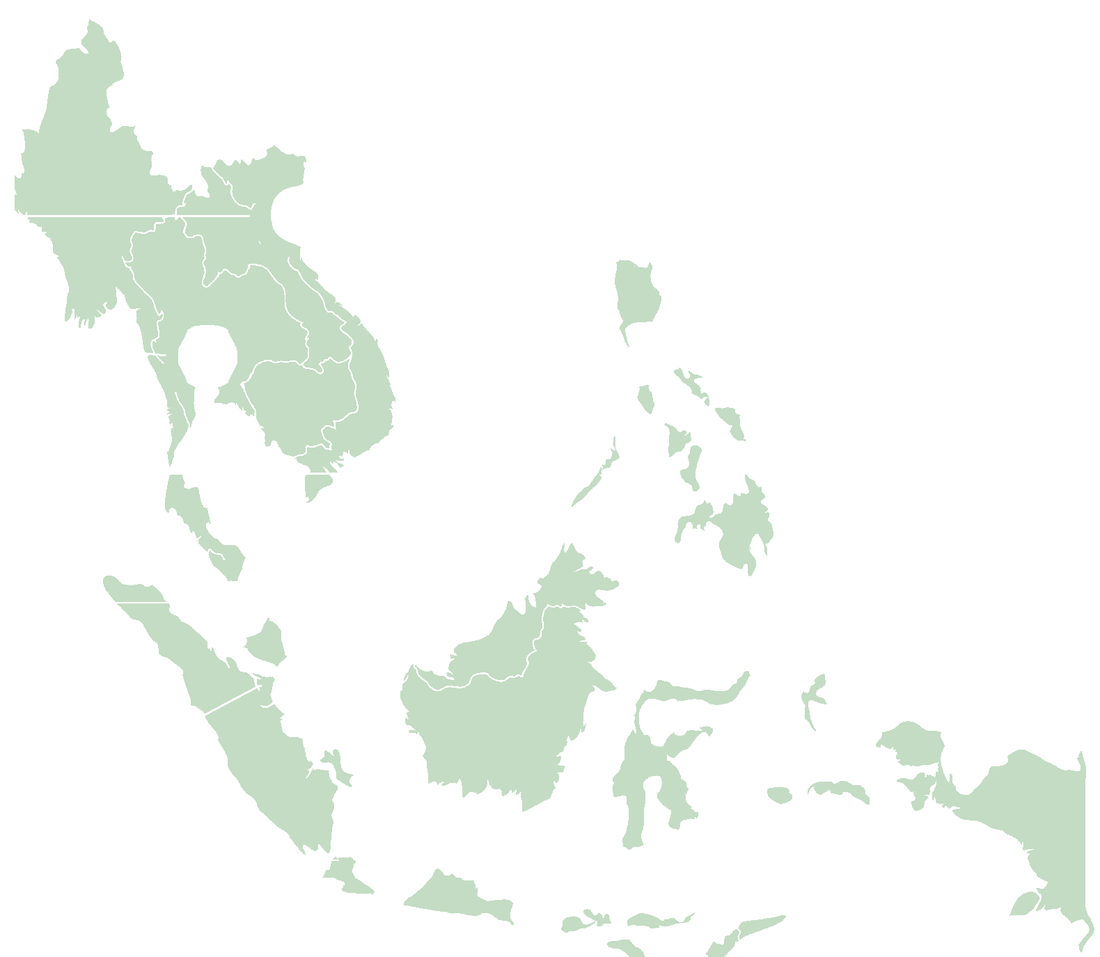
Six countries. One shared transition story. Click a country on the map or in the tabs, then drill in for the full deep-dive.
Companies by country
SEA-6 · 1,150 total
Singapore
The region's diversified hub
Singapore hosts 525 startups — 45% of all SEA-6 — and over half of the region's Built Environment and Climate Markets & Enablers ecosystems. The region's digital and climate operating system.
Philippines
Energy-led ecosystem
72 startups — the smallest count, but the only country where Energy Transition is the top sector. Solar PV is the standout activity in one of the world's most climate-exposed nations.
Vietnam
Most agri-centric in SEA-6
84 startups, with 38% in Nature, Agriculture & Food. PDP8 reorients the power mix toward renewables, LNG and offshore wind, while a US$15.5B JETP underwrites the coal transition.
Thailand
Industrial & agrifood-oriented
114 startups with notable strength in Industrial Decarbonisation. The Bio-Circular-Green (BCG) model, T-VER carbon program, and 30@30 EV manufacturing target define the transition pathway.
Malaysia
Balanced, mid-sized ecosystem
170 startups spread relatively evenly across sectors. NEP, NETR, and MyRER frameworks plus the JS-SEZ are creating a data-centre and green-industrial pipeline anchored by Johor and Penang.
Indonesia
The systems giant
Southeast Asia's largest economy with abundant renewables, vast forests, and the FOLU Net Sink 2030 agenda. 185 startups mirror the structure of the real economy.
Seven sectors. One systems opportunity.
Sectors don't advance in parallel — they advance in relationship. Pick a sector to see the headline activities, and then click through for the complete profile.
Nature, Agriculture & Food
"The region's largest mitigation lever — and the foundation of resilience."
Offers Southeast Asia its fastest, highest-impact emissions reductions. A small share of forests, rice systems, and fertiliser-intensive farms drive most land-use emissions, so targeted interventions yield outsized benefits.
- 5 detailed opportunity areas with concrete innovation directions
- Country distribution + which markets lead
- AI-enabled sub-opportunities specific to this sector
- Featured startups operating in the space
- Cross-references to related country profiles
Energy Transition
"The system bottleneck — and the system catalyst."
Energy demand is soaring, but renewables cannot scale without stronger, smarter, more connected grids. The biggest gains now come from grid upgrades, storage, distributed energy, PPAs, and regional power trade.
- 5 detailed opportunity areas with concrete innovation directions
- Country distribution + which markets lead
- AI-enabled sub-opportunities specific to this sector
- Featured startups operating in the space
- Cross-references to related country profiles
Climate Markets & Enablers
"The 'operating system' of the green economy."
Regulation is forcing companies to measure, verify, and report emissions with precision. MRV systems, carbon markets, ESG automation, and transition finance platforms are becoming the region's core climate infrastructure.
- 5 detailed opportunity areas with concrete innovation directions
- Country distribution + which markets lead
- AI-enabled sub-opportunities specific to this sector
- Featured startups operating in the space
- Cross-references to related country profiles
Built Environment
"Where climate risk meets daily life."
Buildings face rising heat, water stress, and flood risk. The priority is rapid retrofits: efficient cooling, water reuse, smart operations, and nature-based flood protection.
- 5 detailed opportunity areas with concrete innovation directions
- Country distribution + which markets lead
- AI-enabled sub-opportunities specific to this sector
- Featured startups operating in the space
- Cross-references to related country profiles
Transportation & Logistics
"A redesign challenge, not just a vehicle challenge."
Transport emissions stem from system inefficiencies more than engine types. Electrification is accelerating — especially for two- and three-wheelers — but the larger opportunity lies in smarter routing, fleet optimisation, port logistics, and cold chain efficiency.
- 5 detailed opportunity areas with concrete innovation directions
- Country distribution + which markets lead
- AI-enabled sub-opportunities specific to this sector
- Featured startups operating in the space
- Cross-references to related country profiles
Industrial Decarbonisation
"Small sector, huge global stakes."
Industry faces the strongest pressure from EU's CBAM and tightening supply chain requirements. Transforming industrial ecosystems is essential to protecting export competitiveness — through low-carbon materials, electrified heat, CCUS hubs, and data-driven optimisation.
- 5 detailed opportunity areas with concrete innovation directions
- Country distribution + which markets lead
- AI-enabled sub-opportunities specific to this sector
- Featured startups operating in the space
- Cross-references to related country profiles
Circular Economy & Waste
"Turning system inefficiencies into value."
Low recycling rates and infrastructure gaps waste valuable resources, but new EPR and plastics policies are opening markets. High-value opportunities lie in advanced recycling, organic waste valorisation, circular manufacturing, and digital tracking.
- 5 detailed opportunity areas with concrete innovation directions
- Country distribution + which markets lead
- AI-enabled sub-opportunities specific to this sector
- Featured startups operating in the space
- Cross-references to related country profiles
All 1,150 startups. Searchable, filterable, one page.
Every company in this Landscape, in one browsable directory — filter by sector, activity, or country, or search by name and description.
Unlock all six country deep-dives.
And all seven sectors.
Free sign-up gets you the complete report — every country profile, every sector deep-dive, the full capital flows table, and the optional PDF download.